What Attracts Mosquitoes to My Yard in McAllen?
Where Valley Mosquitoes Breed, Rest and Wait
What attracts mosquitoes to my yard in McAllen comes down to water that sits still for about a week and shade to rest in, and this McAllen Pest Defense guide walks a Valley lot spot by spot to find both. Take away the water and the yard stops raising them; deal with the shade and the ones that drift over from next door have fewer places to wait for you.
Three things a mosquito wants from a yard
A mosquito comes to a yard for water to lay eggs in, shade to sit in through the heat of the day, and someone to bite. The last one is you, your family and your pets, and there is no changing it. The first two are where a homeowner has real control. In the Valley the mosquito that ruins a daytime patio is Aedes aegypti, a species that lays in small containers close to houses and seldom travels beyond a couple hundred feet of where it hatched. So the water behind the bites on your porch is usually somewhere on your own lot or the one beside it, not out at a resaca.
How much standing water is enough to breed mosquitoes?
Far less than most people picture. Sonja Swiger, Ph.D., who studies insects for Texas A&M AgriLife Extension, has put it plainly: "Any location that is holding water, even in saturated grassy areas, could be a breeding ground." In an earlier AgriLife Extension article she named water that can collect and stay put for seven to 10 days as the problem. The CDC's figure for an Aedes egg to reach adulthood lands in that same range, 7 to 10 days. That gives every corner of the yard one simple test: could water stay here for a week without anyone noticing?
A spot-by-spot check of a Valley yard
Walk the lot once with that test in mind. These are the places that most often pass it without anyone meaning them to.
| Spot | Why it holds water | What to do |
|---|---|---|
| Plant saucers | Every watering tops them up, and the pot above keeps the water shaded and cool. | Empty them each week and wipe the inside rim, or set the pots straight on the ground. |
| Birdbaths | They are built to hold water, which makes them easy to forget as a breeding site. | Change the water at least once a week and scrub the bowl when you do. |
| Rain gutters | A few leaves at the low end dam a shallow pool that cannot be seen from the ground. | Clear them after storms and check the downspout end first. |
| Toys and play sets | Buckets, wagons, slides and the dip in a plastic seat all catch rain. | Tip them over after play or keep them under a roof. |
| Tarps and covers | Each sag over a grill, a boat or a woodpile becomes a small pond. | Pull covers tight, or fold them away dry. |
| Drains and low spots | French drains, yard drains and dips in the grade stay wet long after a storm. | Flag them for larvicide if they cannot be drained. |
| Fountains and ponds | The water is meant to stay, so tipping is not an option. | These get a bacterial larvicide on the visit instead. |
| Soggy lawn edges | Sprinkler overspray and runoff keep some strips of grass saturated. | Fix leaking heads and water less often, so the grass dries between cycles. |
Why a dry bucket is not an empty one
Aedes aegypti does not drop its eggs onto the water. The CDC describes them being stuck to a container's inner wall a little above the surface, and it puts their survival in a container that dries out at up to 8 months. That is why tipping a bucket is only half the job. The eggs stay on the wall, and the next rain that refills the bucket wakes them up. Scrub the inside of anything that held water, then turn it upside down or put it under cover so it cannot fill again.
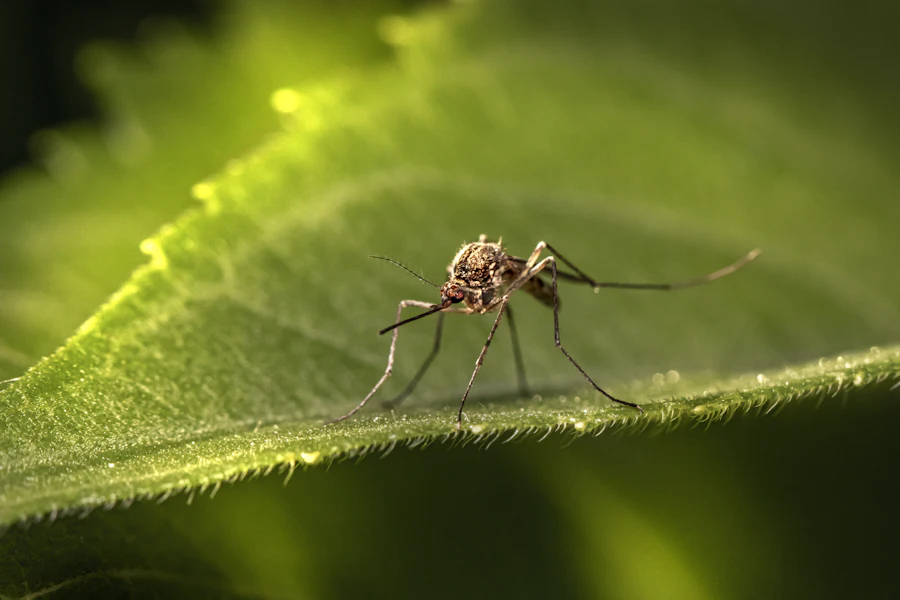
Shade: where the adults sit out a McAllen afternoon
Water explains where mosquitoes come from; shade explains where you run into them. Swiger has noted that on warmer days mosquitoes seek shade, and a Valley summer gives them little else to do: NOAA's 1991 to 2020 normals put McAllen's August high at 99.6°F. The adults settle on the undersides of dense shrubs, under decks and porches, along the shady side of a fence and up under the eaves, and they lift off when someone walks past. Thinning the lowest, thickest growth near the patio lets in sun and moving air and takes some of that cover away. The shaded surfaces that are left are what a barrier treatment is for.
After a Valley rain: the week that counts
Rain restarts the cycle, and in McAllen it does not fall evenly across the year. September is the wettest month on the NOAA normals, carrying roughly one fifth of McAllen's yearly rainfall, and the Valley mosquito calendar covers what that does to the season. What matters for the yard is the week after each real rain:
- Within a day or two, walk the lot with a bucket and tip everything from the table above.
- Look up at the gutters and at any cover that sagged under the weight of the rain.
- Note the lawn edges and low spots that are still wet after two days.
- Before the week is out, walk it again. Anything still holding water gets emptied, scrubbed, or flagged for larvicide.
Water you cannot tip yourself
Some of the water feeding your yard is not yours to empty: a neighbor's lot, a blocked drain along the street, an empty parcel down the block. Because the daytime biter rarely flies far, the house next door counts almost as much as your own, and a friendly word over the fence can do more than any product. At city level, the City of McAllen's Health and Code Enforcement Department is the office that works on mosquitoes. It tracks mosquitoes through a surveillance program run in partnership with Texas A&M and two University of Texas campuses, and it deploys a Vector Control Team once mosquitoes that carry disease turn up in McAllen. That work covers the city as a whole. The saucers, gutters and tarps on a private lot are still the household's to tip.
What a paid yard visit adds
Everything above is free, and it does more than any spray on its own. A visit adds the parts that are hard to do alone: a breeding-site sweep by someone who knows where Aedes lays, a bacterial larvicide (Bti) in water that cannot be dumped, and a barrier treatment on the shaded resting surfaces. The site's published price is $75 to $110 a visit, monthly, on an average lot, with the exact number written down after the free inspection, and McAllen backyard mosquito control, visit by visit shows what each of those three steps involves. What a full McAllen mosquito season costs has a page of its own. A request made through McAllen Pest Defense reaches one independent, licensed Texas pest control company in the Upper Valley, and it inspects the yard, prices it and does the work.
Mosquito words from the yard walk
A container breeder is a mosquito, like Aedes aegypti, that lays in small man-made holders of water rather than in marshes. Source reduction means removing the water itself: tipping, scrubbing, draining. A larvicide treats water that has to stay, and Bti is the bacterial kind. Resting sites are the shaded surfaces adults sit on between bites, and a barrier treatment is the residual product applied to them.
Questions about mosquitoes in the yard
What attracts mosquitoes to my yard?
Can mosquitoes breed in wet grass?
Do mosquito eggs survive after a container dries out?
Who treats the yard?
Find the water first, then treat the shade.
Mosquito yard checks for McAllen, Mission, Edinburg, Pharr & Alamo, with a written quote from a free inspection.
Call (956) 436-5259